Tour 04 - The Stopps
Cofete Day Trip by Car Gravel Road to Punta de Jandía
Morro Jable · Faro de Punta de Jandía · Playa de los Ojos · Mirador de Cofete · Playa de Cofete · Roque del Moro
Full day · rental car with high ground clearance · approx. 180 km · an early start is a must
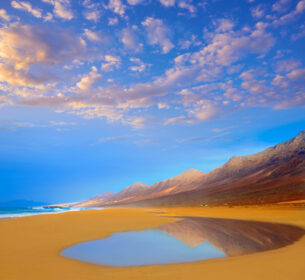
Long, exhausting, unforgettable. This Cofete day trip is the day you will remember later. Not because it was comfortable – but because it was everything Fuerteventura is when nobody is watching: a wild coast, the end of the world, a beach 14 kilometres long where hardly anyone stands except you. The gravel road to the Faro de Punta de Jandía is not an outing. It is an expedition. Anyone who has done it once understands why some people come back every year.
Rental car overview: Rental cars on Fuerteventura
Preparation a must before you set off
This tour gives no second chances to the unprepared. Fill up in Morro Jable – it is the last petrol station before the infrastructure ends. Anyone who forgets is stuck on the track with an empty tank. Pack at least two litres of water per person and take snacks – even though there are restaurants along the way, they are not always open. Download an offline map before you set off – on the gravel road, at the lighthouse and in Cofete there is no signal and no help from Google Maps.
At the end of this page, under Practical, you will find the complete route on Google Maps.
Important about your rental car: Unpaved roads and gravel tracks are excluded from the insurance cover of most rental car companies. This applies to the entire stretch from the end of the paved road behind Morro Jable – that is, to the track to the Faro de Punta de Jandía and the way to Cofete. If there is damage on the track, you are liable yourself without the right additional cover. Check the contract terms before booking, or choose a provider that includes off-road routes.
Alternative: a tour operator for a guided tour.
An early start is the most important thing on this tour. The later you leave, the more stress in the afternoon – and the track is no fun in the dark.
Morro Jable - Coffee & fuel
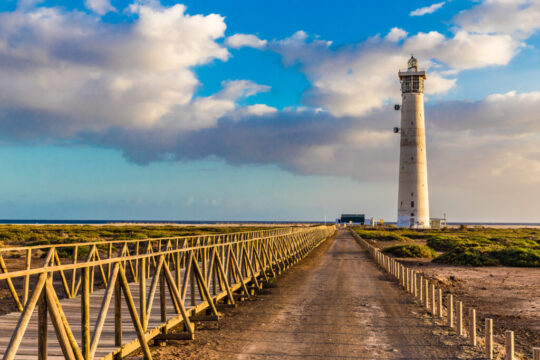
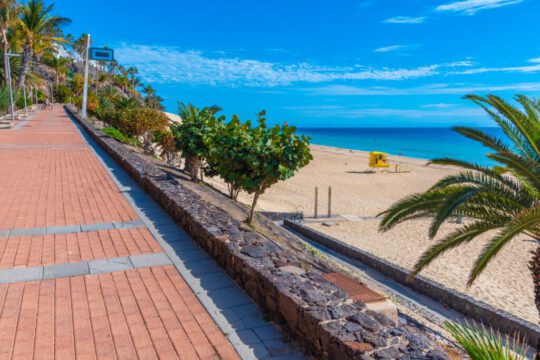
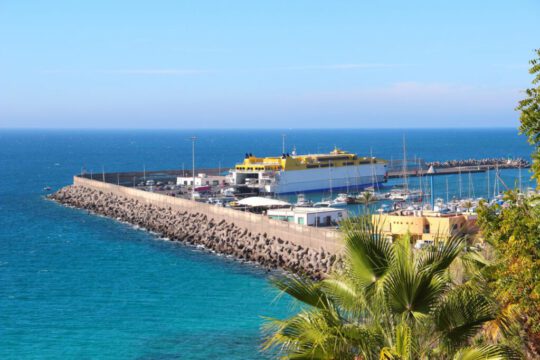
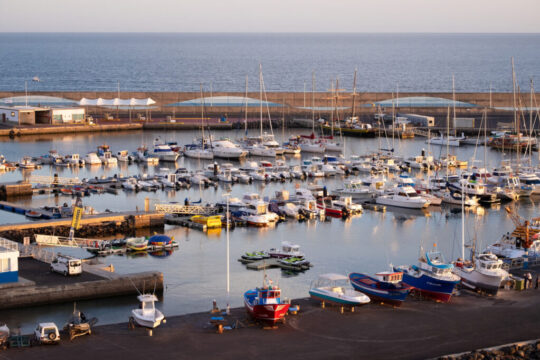
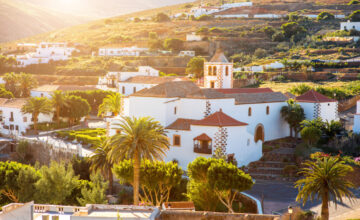
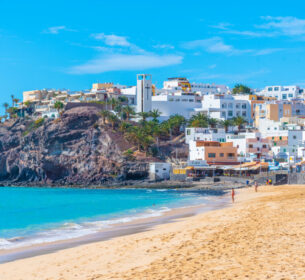
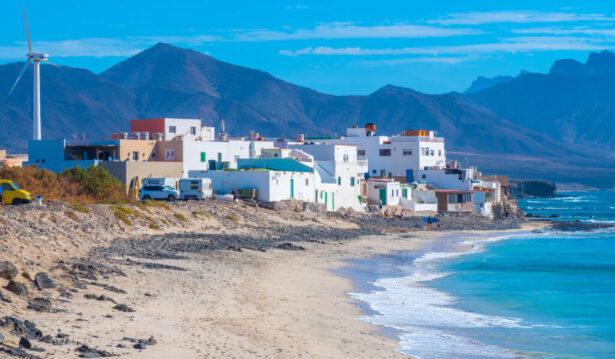
The drive from Costa Calma to Morro Jable leads south on the FV-2 – past the Sotavento lagoon, past wind farms that turn slowly, past small bays on the beach that you mostly ignore on this stretch because the destination is waiting. Let the drive sink in anyway: the Jandía peninsula slowly appears, the mountain range that separates the peninsula from the rest of the island grows larger, and the view of the open sea on your right widens. In Morro Jable: fill up, have breakfast, pop into a supermarket, top up your water. The old town has kept its character – narrow lanes, a small harbour, fishing boats. Ten minutes through the old town if you have time. From here the infrastructure disappears.
Morro Jable – Town description in detail (German)
The gravel road - heading south
We drive from Morro Jable towards the harbour and turn right shortly before it.
Behind Morro Jable a paved road continues a little further south, past the last car park and the last houses – then the asphalt ends. The gravel road begins without much announcement. Width: one car. Condition: variable, depending on the season and the last rain. Speed: 30-40 km/h, no faster. The first kilometres are the hardest – after that the track becomes wider and the rhythm of the road settles in.
The landscape becomes more dramatic with every kilometre. No more houses, no power lines, no fences. Only lava field, Atlantic and sky. The mountain range of Jandía on your right, the open sea on your left, and the track winding through the rock as if someone had simply started driving and never stopped. This is not an outing. This is another world.
Insider tip: Do not rush – the track demands attention and rewards patience. Anyone who drives too fast misses the best and risks a puncture.
Faro de Punta de Jandía The end of the island
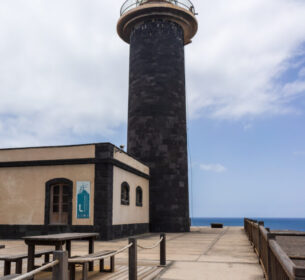
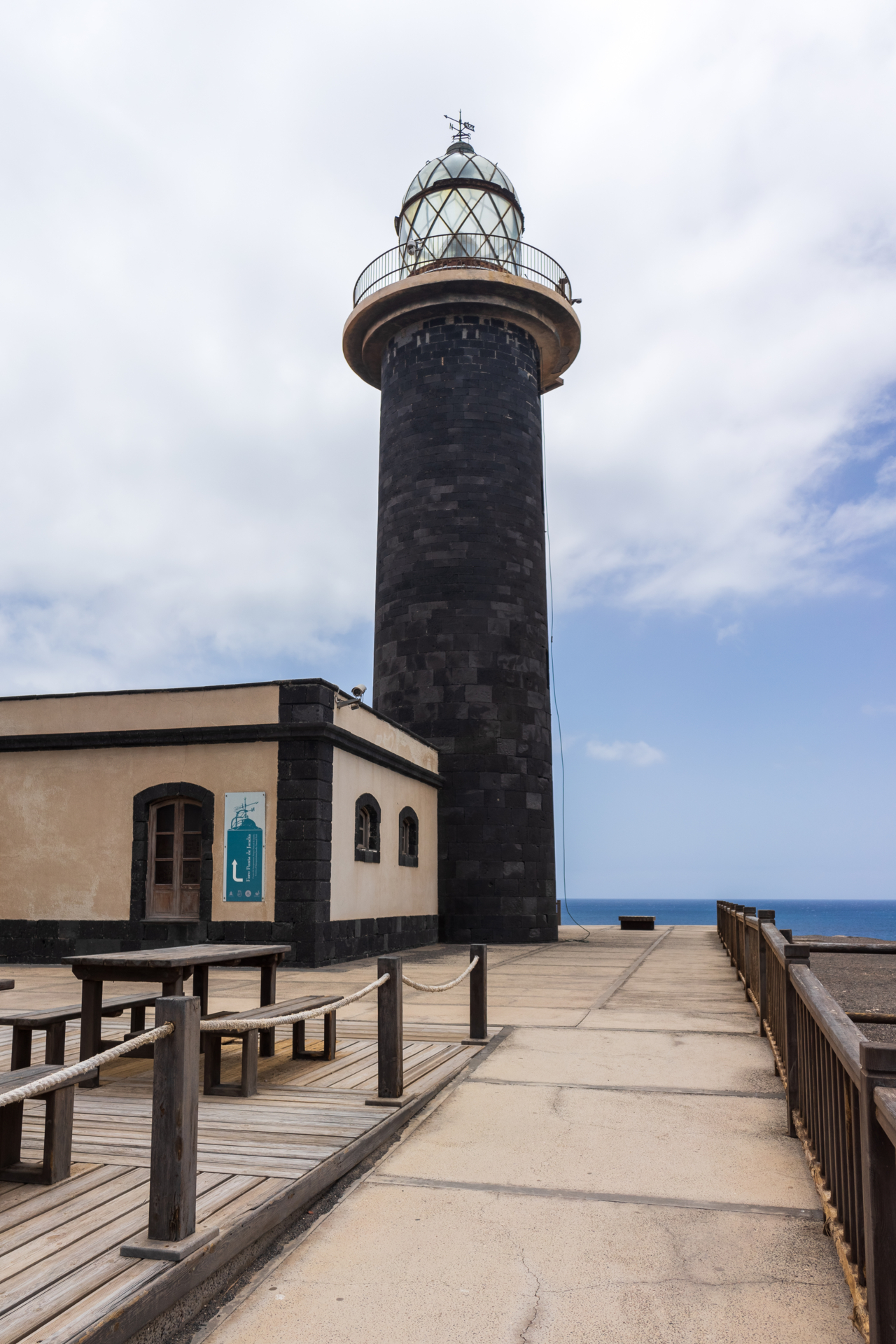
After about an hour on the track it appears: the Faro de Punta de Jandía, built in 1864. It stands on the extreme southwestern tip of Fuerteventura – surrounded by rocks, wind and the open Atlantic on all sides. No people, no noise, no signal. The feeling of standing here has a name: the end of the world. Not as a cliché – as a real physical experience. The wind comes from everywhere at once, the waves break on rocks that have lain exactly here for millions of years, and beyond the horizon lies America.
Park right at the lighthouse. Walk to the rocks by the water and let it sink in. Do not go into the water – the current at the southwestern tip is life-threatening, even if the surface looks calm.
Hidden gem: Faro de Punta de Jandía (German)
Playa de los Ojos The wildest spot on the island
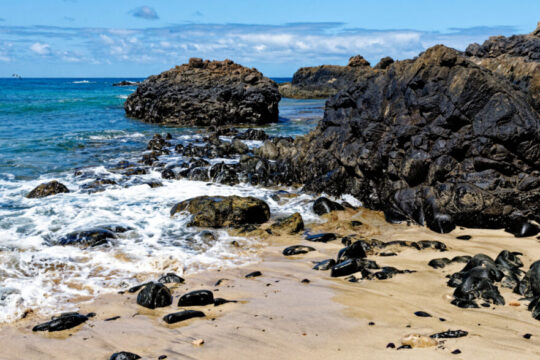
A few kilometres back along the track, then turn left – there lies the Playa de los Ojos, one of the most impressive and least known spots on the whole island. Black basalt rocks, huge waves coming unchecked from the open Atlantic, and in the rocks natural caves and pools that become accessible at low tide – the „eyes“ that give the beach its name. No people, no infrastructure, no noise except the waves breaking. This is Fuerteventura before the first tourist arrived.
Safety: Do not go into the water – the surf and current are extremely dangerous, even if it looks calm.

Restaurante Punta de Jandía Lunch in the middle of nowhere
The Restaurante Punta de Jandía is one of the quirkiest places on the island: in the middle of the track, no asphalt around it, no signal, no comfort – and still full when the weather is good. Simple Canarian cooking, fresh fish when available, cold beer that tastes better here than anywhere else. The experience counts more than the menu. No fixed opening hours – sometimes closed without warning. If it is open: go in and enjoy.
Restaurante Punta de Jandía – Learn more
Restaurante
Punta de Jandia
The drive to Cofete The most demanding part
Now comes the part of the tour that leaves people speechless. From the track the route leads over a mountain ridge to Cofete – winding, bumpy, very narrow in places, with views you did not expect. The drive over the mountain belt of the Jandía peninsula is an experience in itself: on the right the terrain falls steeply to the west coast, on the left you look back over the track you came along, and right at the top of the pass the view of Cofete opens up for the first time. Drive slowly. No hurry. Every bend has a surprise.
Mirador de Cofete One of the best views in Canary Islands
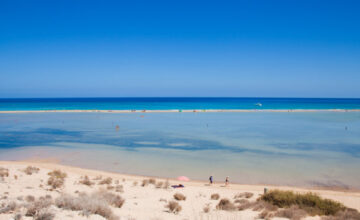
At the pass: the Mirador de Cofete. You drive over the crest and see it for the first time – and this first moment is one of the strongest on the whole island. Fourteen kilometres of white sand, the mountains of the Jandía peninsula as a backdrop, the Atlantic glowing in the afternoon sun, and beyond it nothing until America. No photo or video does it justice. Stop. Get out. Let it sink in.


Playa de Cofete The Highlight
The way down to the beach passes Villa Winter – a mysterious manor house that a German engineer named Gustav Winter built in the 1940s in the middle of this wilderness. What exactly it was for has still not been conclusively clarified: espionage, submarine supply, a private retreat – all the theories are in circulation, none is proven. The house still stands, fights slow decay, and looks as if it had been built precisely to raise questions that nobody can answer. If you are lucky and want to, the door is open and the caretaker lets you in … a peculiar atmosphere greets you – a small donation is welcome.
Down on the beach: fourteen kilometres of wilderness. The sand is light, fine and almost always empty. Walk, take photos, just let it be. If you are hungry: the small Restaurante Cofete right at the entrance to the beach – simple, cult, Canarian cooking. If it is open: ideal. Otherwise a picnic from your rucksack makes more sense here than anywhere else. Taking your rubbish with you should go without saying.
Safety: Do not go into the water – the current at Playa de Cofete is extremely dangerous, even if it looks calm and others are standing in the water. No joke.


Roque del Moro On the way back
On the way back from the beach to the mountain pass – shortly before the climb – lies the Roque del Moro. A basalt rock about 50 metres high that rises vertically out of the sea, just a few metres from the coast. Clearly visible from the track – stop briefly. The name is simple and fitting: „Moro“ here does not stand for Moor in the historical sense, but describes the colour – the deep black lava tower stands out so strikingly from the light sandy beaches around it that the name was almost inevitable. In the afternoon light the rock looks even darker, even more massive – a natural landmark you will not forget so quickly.


The way back Via Morro Jable to Costa Calma
The drive back takes the same route – mountain pass, track, Morro Jable. The landscape looks different on the way back: the light has changed, you now know what to expect, and the track feels calmer. In Morro Jable: last stop, a last drink in the old town or straight on along the FV-2 to Costa Calma. You will be exhausted. That is a good sign – this day has not spared you.
At a glance
Distance: approx. 180 km round trip, of which approx. 60 km gravel road
Rental car: A must – higher ground clearance recommended; check insurance cover on unpaved roads beforehand
Fuel: A must in Morro Jable – the last petrol station before the track
Water & snacks: At least 2 litres per person – restaurants on the track are not always open
Offline map: Download before you set off – no signal on the track and in Cofete
Track speed: Max. 30-40 km/h – do not rush
Safety: Cofete, Playa de los Ojos, Punta de Jandía – do not go into the water, life-threatening current
Budget: approx. 30-50 EUR per person (food and coffee) plus rental car